Sealed
More data neededFs, Qts and Vas are needed for the basic box model. Missing values are not estimated here.
Fs 160 Hz · Qts Not recorded · Vas Not recorded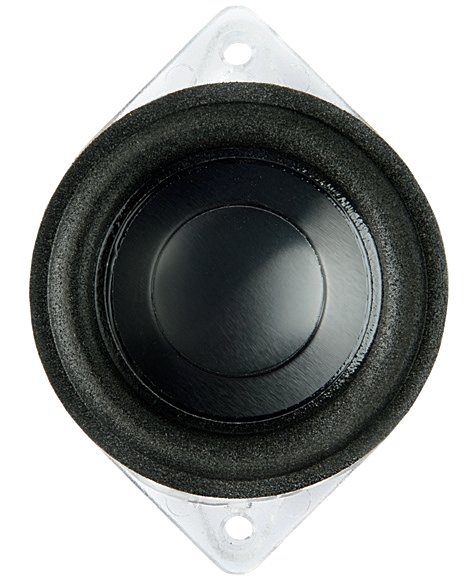 NO PHOTONo photo available
Visaton
Full-range · — · 8 Ω
Visaton BF45S-8: Full-range. Published Fs 160 Hz, Qts Not recorded, Vas Not recorded. Explore these values before choosing an enclosure.
What this driver's data tells us
Visaton BF45S-8 is a Full-range. Its available data describe the following design trade-offs.
T/S parameters describe its bass behavior; they do not establish treble extension, directivity or whether a crossover-free system will meet your needs.
The database lacks Qts, Vas. A dependable enclosure-size and bass-extension assessment needs those values; none have been guessed.
Published sensitivity is 79 dB (1 W / 1 m). Sensitivity describes output for the stated input, not maximum usable sound pressure.
On an approximate 1 W / 1 m basis (79 dB), sensitivity is modest; more input power is needed for the same rated-band output.
Calculated from published parameters; this is not a listening review. Box sizes are net acoustic volume for one driver. Room gain, EQ, damping material and construction losses are excluded.
Voltage-to-power conversion uses nominal impedance. These size, cutoff and sensitivity bands are editorial guides, not audio-quality standards.
Driver character card
These bars show physical quantities, not sound-quality scores. A longer bar is not always better. Open a stat to learn what it means.
The driver's free-air resonance. A lower value can help a bass design, but the enclosure, excursion and response determine usable bass. It is not the finished speaker's bass cutoff.
Output at the manufacturer's stated input and distance. 1 W and 2.83 V are different references for many impedances. This card keeps the original value and reference; it is not an efficiency or sound-quality rating.
Electrical and mechanical damping combined. Lower values indicate stronger damping at resonance. It helps choose an enclosure alignment, but does not tell you whether the sound is fast, warm or detailed.
The volume of air with the same compliance as the suspension. It is not a recommended box volume. Use it together with Fs and Qts.
Published linear excursion. Definitions differ between manufacturers; verify one-way versus peak-to-peak values. It does not by itself predict distortion or maximum safe output.
Effective radiating area, not the frame's outside diameter. It helps estimate how much air a cone moves when combined with excursion.
Sensitivity reference: 1W/1m
Screening guidance from the available parameters, not a guarantee. A manufacturer's exact-model enclosure plan takes priority. Listening quality cannot be ranked from T/S parameters.
Fs, Qts and Vas are needed for the basic box model. Missing values are not estimated here.
Fs 160 Hz · Qts Not recorded · Vas Not recordedFs, Qts and Vas are needed for the basic box model. Missing values are not estimated here.
Fs 160 Hz · Qts Not recorded · Vas Not recordedFs, Qts and Vas are needed for the basic box model. Missing values are not estimated here.
Fs 160 Hz · Qts Not recordedIts full-range role makes a back-loaded design worth investigating, but that is not proof of horn suitability. Check the exact model's recommended plan.
Use an exact-model manufacturer plan or a dedicated horn model. Qts alone cannot establish suitability. Throat, mouth, path and rear chamber must be designed together; this page does not simulate horns.
Fs 160 Hz · Qts Not recordedFs, Qts and Vas are needed for the basic box model. Missing values are not estimated here.
Fs 160 Hz · Qts Not recordedFs, Qts and Vas are needed for the basic box model. Missing values are not estimated here.
Fs 160 Hz · Qts Not recordedFs, Qts and Vas are needed for the basic box model. Missing values are not estimated here.
Fs 160 Hz · Qts Not recordedFs, Qts and Vas are needed for the basic box model. Missing values are not estimated here.
Fs 160 Hz · Qts Not recordedMove the volume slider. Both curves use the same box volume; the bass-reflex tuning is adjustable.
The mini-lab needs valid Fs, Qts and Vas for a bass driver. It stays unavailable when those inputs are missing or the driver has another role.
Unavailable response data is not guessed or plotted.
Attributed summaries, not our listening test or a consensus score. The enclosure, crossover, room and listening level affect each review. Exact model and impedance are checked.
No exact-model listening review has been verified for this page yet. We do not infer tonal quality from T/S parameters or borrow reviews of similar model names.
Compare in USD, EUR or JPY. Prices exclude shipping.
Midwoofer— · 8 Ω
Type unverified— · —
Midrange— · 8 Ω
 NO PHOTONo photo available
Woofer— · 8 Ω
Type unverified— · —
 NO PHOTONo photo available
Woofer— · 8 Ω